LOST VEGAS: The Old Vegas Theme Park
Story summary
Las Vegas has always been brilliant at selling fantasies. One of its earliest and most persistent was the idea that the city grew out of a dusty frontier settlement—a place of cattle drives, saloons, and shootouts. This was the theme of Old Vegas, an amusement park that sold a version of Vegas that
📌 Key Highlights & Takeaways
- Las Vegas has always been brilliant at selling fantasies.
- One of its earliest and most persistent was the idea that the city grew out of a dusty frontier settlement—a place of cattle drives, saloons, and shootouts.
- This was the theme of Old Vegas, an amusement park that sold a version of Vegas that
Las Vegas has always been brilliant at selling fantasies. One of its earliest and most persistent was the idea that the city grew out of a dusty frontier settlement—a place of cattle drives, saloons, and shootouts. This was the theme of Old Vegas, an amusement park that sold a version of Vegas that never existed.
Opened in 1978 along Boulder Highway in nearby Henderson, Nev., Old Vegas was a 55-acre tourist attraction developed by Robert Shelton as a “sister” property to his successful Old Tucson in Arizona. Designed as both a theme park and a working film backlot, Shelton even had Hollywood art directors lay out the streets to accommodate production crews.
The centerpiece was a massive replica of the Old Mormon Fort, the site of the first sustained Euro‑American settlement in the region. The real fort was established in 1855 by Mormon missionaries and abandoned in 1857—a short, harsh experiment in desert living. Old Vegas reimagined it as a frontier fortress housing shops, a steakhouse, a saloon, a 300‑seat theater, and the Hondo Casino, which by 1979 accounted for half the park.
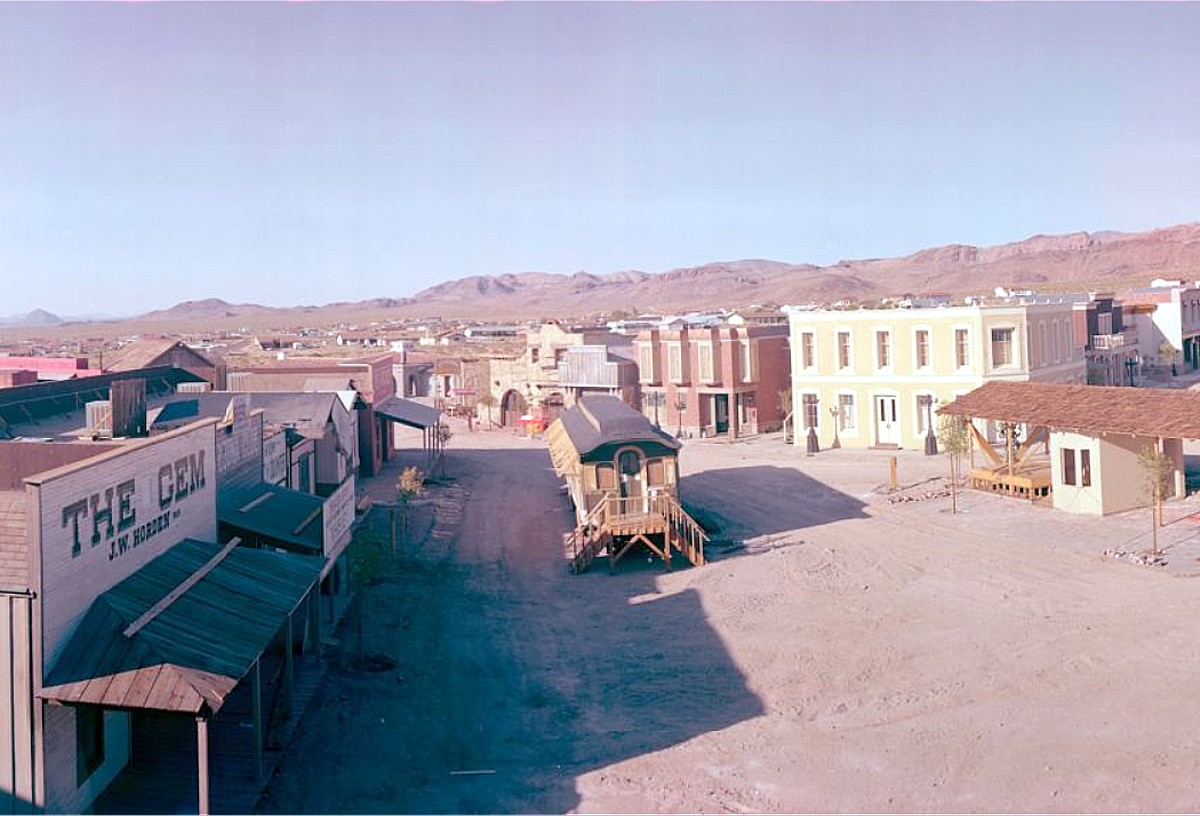
Surrounding the fort was a fabricated Wild West town: boardwalks, stunt shows, stagecoaches, costumed performers, and a railroad that looped around the property.
One genuinely historic element did exist here. In 1978, Old Vegas relocated three surviving guest buildings from El Rancho Vegas, the Strip’s first full‑scale resort, which burned down in 1960. The plan was to restore the structures for future film and television productions, giving the park a ready‑made Western set with authentic Vegas lineage.
Ownership changed almost immediately. In early 1979, TV producer Burt Sugarman and Mexican industrialist Gabriel Alarcón Jr. bought the property and briefly rebranded it as Westworld—not connected to the 1973 Michael Crichton film, but clearly inspired by its theme‑park‑gone‑wrong aesthetic. Their ambitions were bigger: more rides, a video arcade, a train exhibit, and even a plan to screen Priscilla Presley’s private Elvis home movies.
But Westworld collided with the real world. Alarcón was denied a Nevada gaming license because investigators couldn’t trace the source of his money under Mexico’s accounting rules. The casino was half the park’s revenue, and without it, the business model wobbled. Attendance never stabilized, and by late 1979 the park reverted to the Old Vegas name.
Phase Two opened in 1980, adding a railroad museum, barbecue areas, and the Eureka Locomotive, along with equipment from the Virginia & Truckee Railroad. More rides were planned, but financial losses mounted. By 1982, renovation plans were shelved, and Old Vegas increasingly relied on bus tours rather than locals or Strip visitors.
Editorial Text & Content Analyzer
Analyze real-time word count, reading speed, and text density metrics on the fly.
Source: Casino.org.
Read the full story at the original source ↗
For questions: mrsmithcons@gmail.com.
❓ Frequently Asked Questions (VIP Vegas Life Briefing)
What table limits apply to VIP Vegas Life VIP high-roller suites?
Selected Salon Privé partners in Monaco, Macau, and Las Vegas feature minimums from $5,000 up to $250,000 per hand, complemented by dedicated VIP concierge hosts and private cages.
How are VIP cashback and rebate percentages structured?
Tiered high-roller programs credit weekly theoretical loss rebates between 12% and 18% with zero turnover wagering restrictions, directly into preferred cryptocurrency or wire accounts.
What progressive jackpot verification safeguards are in place?
All linked progressive prize pools are audited by licensed third-party testing authorities (eCOGRA, GLI) ensuring algorithmic fairness and guaranteed immediate liquidity disbursement.
🎲 High Roller Limit Sheet & VIP Comp Matrix
Privileged table access, cashback tiers, and high-limit baccarat strategies.
⚡ Enter High Limit VIP Room ➔More from WinBar VIP
Nintendo has no plans to ditch physical games for Switch 2
Nintendo says it has no plans to abandon physical Switch 2 games, despite Sony's decision to end new PlayStati...
 🌿 SkyFree Living
Tiny Life Cahaba: A Single-Level Park Model with a Bedroom Deck at Peaceful Meadows
Tiny Life's Cahaba is a 395 sq ft single-level park model with a galley kitchen, a bright blue fridge, and a b...
 🔥 ViralBuzz 168
36 New “Off The Leash” Comics That Perfectly Capture Life With Dogs
British cartoonist Rupert Fawcett knows how to find humor in these everyday moments. His comic series Off The ...
⚡ CyberTech 568
Flox Intelligence is building AI to keep wildlife away from trains, airports, and roads
Flox's edge devices can identify animals and use species-specific sounds to drive them away from critical infr...